Real Estate Investor SEO: Rank “We Buy Houses” & Get Free Leads
What is SEO for real estate investors?
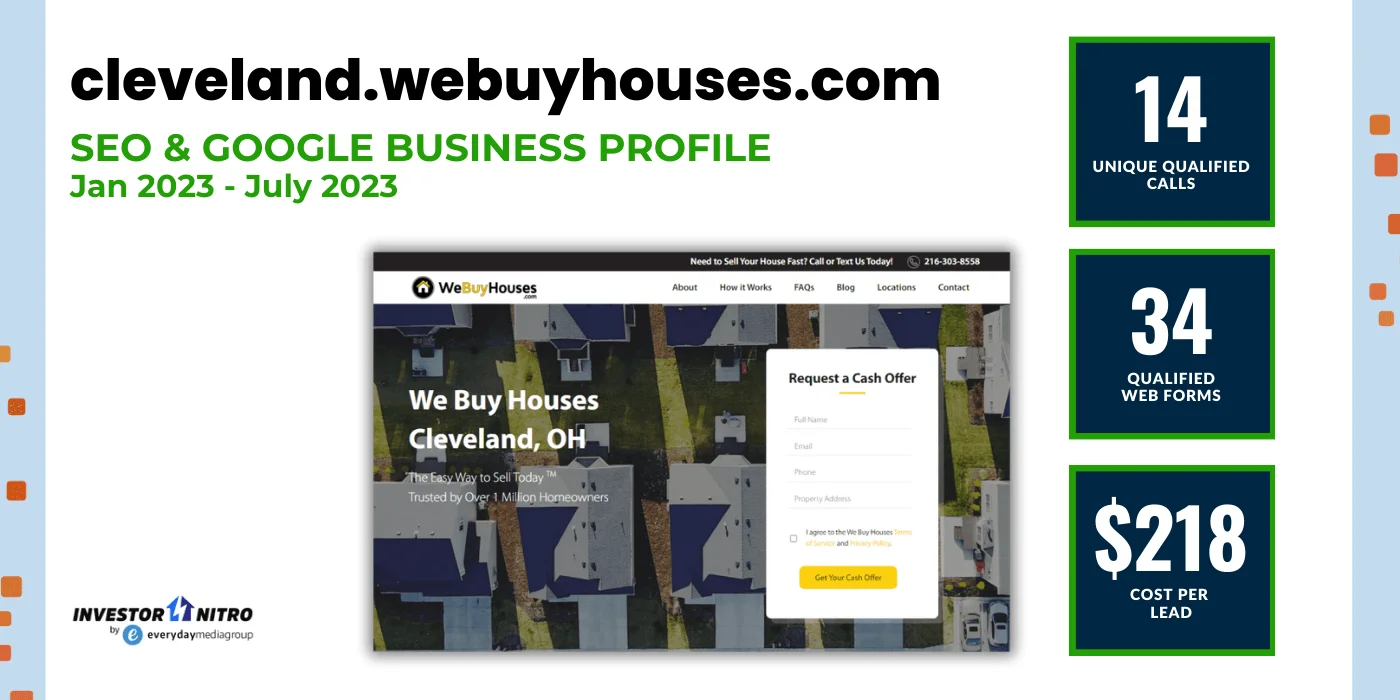
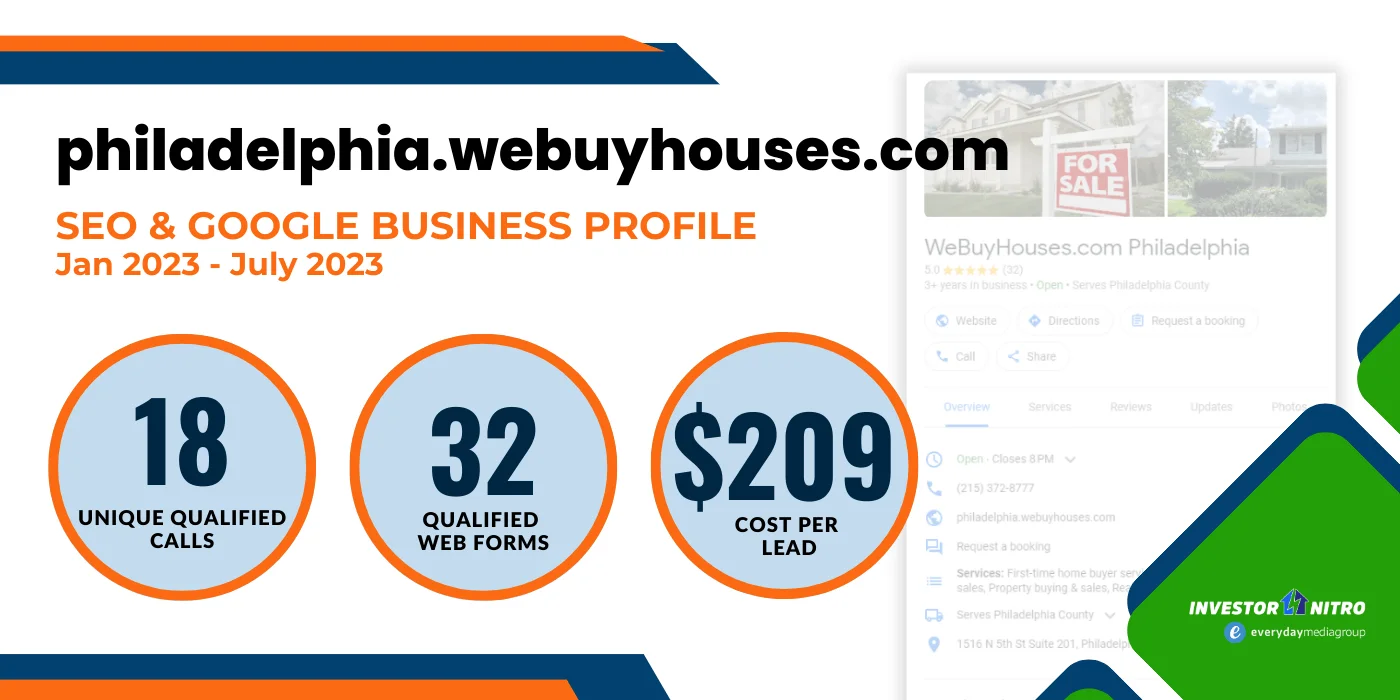
SEO for real estate investors is optimizing your website to rank organically in Google for motivated seller keywords like “sell my house fast [city]” and “we buy houses [city].” Unlike PPC advertising, organic rankings generate free leads indefinitely. Investors ranking #1 for target keywords typically generate 50-100+ qualified motivated seller leads per month without ongoing ad spend.

Timeline: 3-6 months to see initial results, 6-12 months for consistent lead flow Cost per lead: $0 after initial investment (vs. $80-$150 per PPC click) Best for: Investors operating in markets for 12+ months seeking sustainable lead generation
Key Takeaways
- SEO targets motivated sellers, not buyers: Rank for “sell my house fast [city]” and “we buy houses [city]” — not agent or buyer queries
- Free organic leads: Once ranking, motivated seller leads cost $0 per click vs. $80-$150 for PPC
- 3-6 month timeline: Initial results take time, but rankings compound exponentially after 6-12 months
- 50-100+ monthly leads: Top-ranking investors generate this volume on autopilot in competitive markets
- Four core pillars: Local SEO, content marketing, backlink building, and technical optimization
What is SEO for Real Estate Investors?
SEO for real estate investors is the strategic process of optimizing your website and digital presence to achieve top Google rankings for motivated seller search queries. These queries include:
- “sell my house fast Dallas”
- “cash home buyers Phoenix”
- “we buy houses Atlanta”
- “sell inherited house quickly”
The Core Objective
When distressed property owners search for solutions, your business appears at the top of organic search results — not competitors, not Zillow, not traditional real estate agents.
SEO vs. PPC: The Economics
| Metric | PPC (Paid Ads) | SEO (Organic) |
| Cost per click | $80-$150 | $0 |
| Monthly ad spend | $5,000-$15,000 | $0 (after setup) |
| Lead sustainability | Stops when budget ends | Continues indefinitely |
| Timeline to results | Immediate | 3-6 months |
| Long-term ROI | Decreasing (costs rise) | Increasing (compounds) |
Once you’re ranking organically, motivated seller leads flow continuously without ongoing advertising costs. This is why experienced investors often phase out PPC entirely or reserve it only for new market testing.
Why REI SEO is Different from Traditional Real Estate SEO
If you’ve researched “real estate SEO,” you’ve likely encountered advice about MLS optimization, neighborhood guides, and agent branding. That’s not real estate investor SEO.
Critical Differences
Real Estate Agents optimize for:
- Buyer keywords: “homes for sale in Dallas,” “best neighborhoods in Phoenix”
- Branding and authority
- Market reports, staging tips, community guides
- Long-term relationship building
Real Estate Investors optimize for:
- Seller keywords: “sell my house fast Dallas,” “cash home buyers Phoenix”
- Direct response and immediate conversions
- Urgent problem-solving content: foreclosure avoidance, probate, major repairs
- Transaction-focused landing pages
User Intent Distinction
- Homebuyer intent: Shopping, comparing, long decision timeline
- Motivated seller intent: Problem-solving, urgent need, short decision timeline
Your SEO strategy must reflect this fundamental difference. Generic real estate tactics designed for agents waste time and budget.
The Four Pillars of REI SEO
Effective SEO for real estate investors requires mastery of four interconnected pillars. Neglecting any single pillar significantly undermines ranking potential.
1. Local SEO: Dominate “We Buy Houses [City]” Searches
Why local matters: 73% of motivated seller searches include location modifiers (“sell my house fast Austin,” “cash for houses Miami”). Local SEO is less competitive than national rankings.
Essential Local SEO Components
Google Business Profile Optimization
- Claim and verify your GBP listing
- Add all service areas and cities you operate in
- Upload high-quality photos (office, team, properties)
- Collect 25+ verified Google reviews (4.5+ star average)
- GBP listings appear in the local 3-pack above organic results
City-Specific Landing Pages
- Create dedicated pages for each operating city
- Bad: One generic “we buy houses DFW” page
- Good: Separate optimized pages for Dallas, Fort Worth, Plano, Irving, Arlington
- Each page must have unique content (not duplicated)
Local Citations
- List your business in 50+ local directories
- Critical platforms: Yelp, YellowPages, Manta, BBB, local Chamber of Commerce
- Maintain consistent NAP (Name, Address, Phone) across all platforms
- Inconsistent NAP confuses Google and damages rankings
Local Backlinks
- Links from local news sites, blogs, community organizations
- Example: Link from Dallas Morning News > 50 generic directory links
- Target: 10-20 high-quality local backlinks within first 6 months
Ranking Impact: Local SEO can achieve page 1 rankings 60% faster than national strategies. Ranking #1 for “we buy houses Tucson” takes 4-6 months vs. 12-18 months for national “we buy houses” rankings.
2. Content Marketing: Answer the Questions Motivated Sellers Ask
Distressed property owners search for information before contacting buyers. Your content must provide authoritative answers while positioning your business as the solution.
High-Converting Content Topics
Foreclosure-Related:
- “How to sell a house in foreclosure [state]”
- “Can I sell my house if I’m behind on mortgage payments?”
- “What happens if I stop paying my mortgage?”
- “Foreclosure timeline: what to expect in [state]”
Probate & Inherited Properties:
- “Selling an inherited house: probate process explained”
- “How to sell inherited property with multiple heirs”
- “Tax implications of selling inherited property”
Property Condition Issues:
- “Can I sell my house if it needs major repairs?”
- “Selling a house with foundation problems”
- “How to sell a fire-damaged property”
- “Selling a house with code violations”
Life Situation Challenges:
- “Sell house during divorce: what you need to know”
- “How to sell a house when relocating for work”
- “Selling property in bankruptcy”
Comparison Content:
- “Cash offer vs. listing with an agent: which is better?”
- “How much do real estate agents really cost?”
- “iBuyer vs. local cash buyer: pros and cons”
Content Optimization Checklist
Each blog post must:
- Provide genuine value – Answer questions thoroughly; avoid thin content
- Target long-tail keywords – “Sell inherited house quickly Dallas” (easier to rank) vs. “sell house fast” (highly competitive)
- Include internal links – Link to relevant city landing pages and service pages
- Add clear CTAs – Every post ends with “If you’re facing [situation], we can help. Get a cash offer in 24 hours.”
- Optimize for featured snippets – Use question headings, bullet points, concise answers
- Include statistics and data – Builds authority and attracts backlinks
Content Performance Benchmark: Publish 2-4 high-quality blog posts monthly. After 6 months, content should drive 30-40% of organic traffic.
3. Backlink Building: Earn Authority Signals
Google’s ranking algorithm heavily weighs site authority, which is primarily determined by backlink quality and quantity. More high-quality backlinks = higher rankings.
Effective Backlink Strategies for REI
Guest Posting on Real Estate Investor Sites
- Target platforms: BiggerPockets, REtipster, Connected Investors, FortuneBuilders blog
- Value: One backlink from BiggerPockets (DR 80+) = 100 low-quality directory links
- Frequency: 1-2 guest posts monthly
Local News & Media Coverage
- Pitch local journalists stories about:
- Market trends and data
- First-time homebuyer programs
- Affordable housing initiatives
- Community impact stories
- Include link back to your site in author bio or article
- Value: Local news backlinks boost local rankings significantly
Strategic Partnerships
- Contractors, property managers, title companies, real estate attorneys
- Create “preferred vendor” pages with reciprocal links
- Value: Relevant, local backlinks from complementary businesses
Linkable Assets & Data
- Create shareable resources:
- “Average days to foreclosure by state” (data study)
- “Home value calculator” (interactive tool)
- “Complete guide to selling inherited property” (ultimate guide)
- Naturally attract backlinks from other sites citing your data
Broken Link Building
- Find broken links on real estate sites
- Offer your content as replacement
- Lower competition, high success rate
Backlink Quality Metrics
Prioritize:
- Domain Rating (DR) 40+ sites
- Relevant real estate or local sites
- Followed links (not nofollow)
- Contextual links (within article body)
Avoid:
- Purchasing links from link farms
- Blog comment spam
- Low-quality directory submissions
- PBN (Private Blog Network) schemes
Target: 15-25 high-quality backlinks in first 6 months, 50+ within 12 months.
Warning: Google penalizes spammy link-building tactics. Focus on quality over quantity. One penalty can erase months of progress.
4. Technical SEO: Make Sure Google Can Crawl and Rank Your Site
Outstanding content and backlinks become irrelevant if technical issues prevent Google from properly crawling, indexing, and ranking your site.
Critical Technical SEO Elements
Mobile Optimization (Priority #1)
- Statistic: 72% of motivated seller searches occur on mobile devices
- Requirements:
- Responsive design that adapts to all screen sizes
- Click-to-call buttons prominently displayed
- Fast mobile load time (under 3 seconds)
- Easy form completion on mobile
- Impact: Non-mobile-optimized sites lose 50-70% of potential traffic
Page Speed Optimization
- Target: Load time under 3 seconds (under 2 seconds ideal)
- Optimization tactics:
- Compress images (use WebP format)
- Enable browser caching
- Minimize JavaScript and CSS
- Use Content Delivery Network (CDN)
- Implement lazy loading for images
- Impact: 1-second delay = 7% conversion loss
Schema Markup (Structured Data)
- Essential schema types for REI:
- LocalBusiness schema
- Service schema
- FAQ schema
- Review schema
- BreadcrumbList schema
- Benefit: Helps Google understand your content, increases rich snippet chances
XML Sitemap
- Submit sitemap to Google Search Console
- Ensures Google discovers all important pages
- Update sitemap when adding new content
SSL Certificate (HTTPS)
- Non-negotiable: Google penalizes non-secure (HTTP) sites
- Cost: Free via Let’s Encrypt
- Impact: HTTPS is confirmed ranking factor
Core Web Vitals
- Largest Contentful Paint (LCP): Under 2.5 seconds
- First Input Delay (FID): Under 100 milliseconds
- Cumulative Layout Shift (CLS): Under 0.1
URL Structure
- Clean, descriptive URLs
- Good: yoursite.com/sell-house-fast-dallas
- Bad: yoursite.com/page?id=12345
- Include target keyword in URL when possible
Technical SEO Audit Checklist
- Site loads under 3 seconds on mobile
- All pages are HTTPS (SSL certificate installed)
- XML sitemap submitted to Google Search Console
- Schema markup implemented on key pages
- No broken links (404 errors)
- Proper canonical tags to avoid duplicate content
- Clean URL structure with descriptive slugs
- Image alt text includes relevant keywords
- Mobile-friendly test passed (Google tool)
- No crawl errors in Search Console
How Long Does REI SEO Take? (Realistic Timeline)
SEO is not instant gratification. Beware any agency promising “page 1 rankings in 30 days” — they’re either lying or using black-hat tactics that will result in Google penalties.
Month-by-Month Expectations
Months 1-2: Foundation Phase
- Technical website setup and optimization
- Comprehensive keyword research
- Initial content creation (4-8 blog posts)
- Google Business Profile optimization
- Local citation building begins
- Expected results: Minimal traffic, no leads yet
- Why: Google needs time to crawl, index, and assess your site
Months 3-4: Emergence Phase
- Site begins appearing on pages 2-3 for target keywords
- Some long-tail keywords may reach page 1
- Content library grows to 10-15 posts
- First backlinks acquired
- Expected results: 2-5 organic leads, pages 2-3 rankings
- Why: Google is testing your rankings, assessing user engagement
Months 5-6: Acceleration Phase
- Rankings improve to page 1 for long-tail keywords
- Main city keywords reach page 2-3
- Organic traffic increases 3-4x from month 1
- Backlink profile strengthens
- Expected results: 5-15 organic leads per month
- Why: Content gains authority, technical signals strengthen
Months 6-12: Domination Phase
- Page 1 rankings solidify for core keywords
- “We buy houses [city]” keywords reach positions 1-5
- Content ranks for hundreds of long-tail variations
- Local 3-pack visibility achieved
- Expected results: 20-50+ organic leads per month (market dependent)
- Why: Compounding effect of content, backlinks, and technical optimization
Month 12+: Sustained Growth Phase
- SEO becomes #1 lead source
- Rankings for 300-500+ keyword variations
- Brand searches increase significantly
- Competitor displacement in local markets
- Expected results: 50-100+ organic leads per month in competitive markets
- Why: Established authority, comprehensive content coverage, strong backlink profile
Key Performance Indicators (KPIs) to Track
Traffic Metrics:
- Organic sessions month-over-month
- Pages per session
- Average session duration
- Bounce rate (under 60% is good)
Ranking Metrics:
- Keyword positions for target terms
- Number of keywords ranking in top 10
- Local 3-pack visibility
- Featured snippet captures
Conversion Metrics:
- Organic form submissions
- Phone calls from organic traffic
- Cost per organic lead ($0 ongoing)
- Organic lead-to-deal conversion rate
Authority Metrics:
- Domain Rating (DR) or Domain Authority (DA)
- Number of referring domains
- Quality of backlink profile
SEO vs. PPC: Which Should You Invest In?
This is the most common question real estate investors ask: “Should I do SEO or PPC?”
The strategic answer: Both, but with different timing and purposes.
When PPC Makes Sense
- Just starting your REI business – Need immediate lead flow while building SEO
- Entering new markets – Want fast data on lead quality and conversion rates
- SEO not ranking yet – Fill the gap during months 1-6 of SEO buildout
- Have available budget – Can afford $5K-$15K/month for predictable lead volume
- Testing new messaging – Want to quickly validate offers and landing pages
- Seasonal campaigns – Ramp up during peak seller season
When SEO Makes Sense
- Want free leads long-term – Eliminate ongoing ad spend once ranking
- PPC costs are rising – Competition increasing, CPCs climbing from $50 to $150+
- Stability in market – Operating in same cities for 12+ months
- Building brand authority – Want to dominate local search presence
- Predictable deal volume – Need consistent baseline of free leads
- Higher profit margins – Free leads = higher net profit per deal
The Optimal Strategy: Sequential Investment
Phase 1 (Months 1-6): PPC + SEO Foundation
- Run PPC campaigns for immediate leads
- Invest in SEO setup (technical, content, citations)
- PPC generates revenue to fund SEO investment
- PPC provides data to inform SEO keyword targeting
Phase 2 (Months 6-12): PPC + Growing SEO
- Continue PPC at same budget
- SEO begins generating 30-40% of leads
- Total lead volume increases
- Cost per lead decreases overall
Phase 3 (Month 12+): SEO-Dominant + Selective PPC
- SEO generates 60-80% of leads
- Reduce PPC budget by 50%
- Use PPC only for new markets or testing
- Dramatically improved profit margins
Real-World Example
Investor: Dallas Market
Before SEO (PPC Only):
- Monthly PPC spend: $10,000
- Average CPC: $125
- Clicks per month: 80
- Lead conversion rate: 40%
- Leads per month: 32
- Cost per lead: $312.50
After 12 Months of SEO:
- Monthly PPC spend: $3,000
- Organic leads: 45/month
- PPC leads: 10/month
- Total leads: 55/month
- Cost per lead: $54.55 (83% reduction)
- SEO lead cost: $0
Result: 72% more leads at 83% lower cost per lead.
Common REI SEO Mistakes to Avoid
1. Using Agent-Focused SEO Tactics
Mistake: Optimizing for “homes for sale” instead of “sell my house fast”
Fix: Target motivated seller keywords exclusively
2. Thin Content
Mistake: 300-word blog posts with no real value
Fix: 1,500-2,500 word comprehensive guides answering real questions
3. Ignoring Mobile Optimization
Mistake: Site doesn’t work properly on phones
Fix: Mobile-first design with fast load times
4. No Local SEO Strategy
Mistake: Generic national approach without city-specific pages
Fix: Dedicated landing pages for each operating city
5. Buying Low-Quality Backlinks
Mistake: Purchasing 1,000 directory links for $99
Fix: Earn 10-20 high-quality, relevant backlinks
6. Expecting Instant Results
Mistake: Giving up after 2 months with no results
Fix: Commit to 6-12 month timeline for meaningful ROI
7. Not Tracking Properly
Mistake: No idea which keywords drive leads
Fix: Implement call tracking, form analytics, and conversion tracking
8. Duplicate Content Across Cities
Mistake: Same content on Dallas, Fort Worth, and Plano pages
Fix: Unique, localized content for each city page
Why Choose InvestorNitro for REI SEO
We don’t do generic SEO. We specialize exclusively in real estate investor SEO — which means we understand:
Motivated Seller Psychology
We know exactly what distressed sellers search for, what questions they ask, and how they evaluate cash buyer options. Our content and targeting reflect this deep understanding.
Competitive REI Landscape
We continuously track what Opendoor, Offerpad, HomeVestors, and local competitors rank for — and we know precisely how to outrank them.
REI Deal Economics
We optimize for cost per deal, not vanity metrics like traffic. A site with 500 monthly visitors generating 10 deals beats a site with 5,000 visitors generating 2 deals.
Integrated Marketing Approach
Most agencies silo SEO, PPC, and GEO optimization. We build them together so each channel reinforces the others, maximizing your total ROI.
Proven Track Record
We’ve worked exclusively with real estate investors since day one. We don’t serve agents, brokers, or traditional businesses. You’re not our side hustle — real estate investor marketing is our sole focus.
Comprehensive Service Delivery
- Technical SEO: Complete site optimization
- Content Creation: Expert-written, converting content
- Link Building: White-hat, sustainable backlink acquisition
- Local SEO: GBP management, citations, local links
- Performance Tracking: Detailed monthly reporting and analytics
Ready to Stop Paying $80-$150 Per Click?
If you’re spending $5,000-$10,000+ monthly on PPC and want to build a sustainable, long-term organic lead source that generates free motivated seller leads indefinitely — let’s talk.
What You Get: Free SEO Audit & Strategy Session
We’ll provide a comprehensive analysis including:
Current Keyword Rankings
- Where you rank now for “we buy houses [city]” and related terms
- Exact positions for your target keywords
- Competitor ranking comparison
Technical SEO Issues
- Site speed and mobile optimization problems
- Missing schema markup opportunities
- Crawl errors blocking your rankings
Content Gap Analysis
- Topics your competitors rank for that you’re missing
- High-converting content opportunities
- Quick-win keyword targets
Backlink Profile Assessment
- Current backlink quality and quantity
- Toxic links that may be harming your rankings
- High-value backlink opportunities
Local SEO Opportunities
- Google Business Profile optimization needs
- Citation building requirements
- Local 3-pack visibility potential
6-Month Roadmap to Page 1
- Month-by-month action plan
- Realistic timeline for rankings
- Expected lead volume projections
Zero Obligation. Zero Cost. Just Actionable Insights.
Even if you don’t work with us, you’ll walk away with a clear understanding of:
- Why you’re not ranking now
- What needs to be fixed
- How to achieve page 1 rankings in your markets
This audit typically costs $1,500 — you get it free.
Get Your Free SEO Audit Now
Or call us directly: 817-826-9451
Stop renting leads from Google Ads. Start owning your lead flow with SEO.
Frequently Asked Questions (FAQs)
How long does SEO take to work for real estate investors?
Real estate investor SEO typically shows initial results in 3-6 months, with significant lead generation beginning around month 6-12. Page 1 rankings for competitive keywords like “we buy houses [city]” generally require 6-12 months of consistent optimization. However, long-tail keywords (e.g., “sell inherited house fast Dallas”) can rank faster, often within 3-4 months. SEO is a long-term investment that compounds over time — once you’re ranking, leads continue flowing indefinitely without ongoing ad spend.
What’s the difference between real estate investor SEO and agent SEO?
Real estate investor SEO targets motivated seller keywords (“sell my house fast,” “cash home buyers”) while agent SEO targets buyer keywords (“homes for sale,” “best neighborhoods”). Investors need direct-response content addressing urgent problems (foreclosure, probate, repairs), whereas agents focus on market reports and community guides. The user intent is completely different: sellers are problem-solving with urgency, buyers are shopping with long timelines. Using agent SEO tactics for investor marketing wastes time and budget.
How much does SEO cost compared to PPC for real estate investors?
PPC costs $80-$150 per click in competitive real estate investor markets, resulting in $5,000-$15,000+ monthly ad spend. SEO requires an upfront investment of $2,000-$5,000/month for 6-12 months, after which organic leads cost $0 per click indefinitely. Once ranking, investors typically generate 50-100+ free leads monthly. The breakeven point usually occurs around month 8-10, after which ROI dramatically exceeds PPC. Long-term, SEO provides 10-20x better ROI than PPC.
Can I do SEO myself or should I hire an agency?
DIY SEO is possible but requires 15-20 hours weekly and expertise in technical optimization, content writing, link building, and local SEO. Most investors lack this time and skillset. The cost of hiring an experienced REI SEO agency ($2,500-$5,000/month) is typically lower than the opportunity cost of learning and executing yourself. However, agencies delivering generic SEO (not REI-specific) often waste money. Choose specialists who understand motivated seller psychology and REI keyword targeting.
What keywords should real estate investors target for SEO?
Primary keywords: “we buy houses [city],” “sell my house fast [city],” “cash home buyers [city],” “sell house as-is [city].” Secondary keywords: “sell inherited house [city],” “avoid foreclosure [city],” “sell house during divorce,” “cash for houses [city],” “sell house with code violations.” Long-tail keywords: “can I sell my house if it needs major repairs [city],” “how to sell a house in foreclosure [state],” “selling inherited property with multiple heirs.” Target 3-5 primary keywords per city, 20-30 secondary keywords, and 50-100+ long-tail variations.
How many leads can I expect from SEO once ranking?
Lead volume depends on market size and competition. Small markets (population under 100K): 10-25 organic leads monthly. Medium markets (100K-500K population): 25-50 leads monthly. Large markets (500K+ population): 50-100+ leads monthly. Investors ranking #1 for “we buy houses [city]” in competitive markets like Dallas, Phoenix, or Atlanta typically generate 75-150+ organic leads monthly. Lead quality also improves with SEO — organic leads convert 20-30% higher than PPC leads because of increased trust from organic rankings.
Is SEO or PPC better for real estate investors?
Both serve different purposes. PPC provides immediate leads and is ideal when starting, testing new markets, or during SEO’s 3-6 month ramp-up period. SEO provides free long-term leads and is superior once ranking. The optimal strategy: start with PPC for immediate revenue while building SEO in the background. By month 6-12, SEO takes over as the primary lead source. After 12 months, investors typically reduce PPC spend by 50-70% and rely on SEO for baseline lead volume, using PPC selectively for new markets or seasonal campaigns.
What are the four pillars of real estate investor SEO?
The four essential pillars are: (1) Local SEO — Google Business Profile optimization, city-specific landing pages, local citations, and local backlinks to dominate “we buy houses [city]” searches. (2) Content Marketing — Publishing comprehensive guides answering motivated seller questions (foreclosure, probate, repairs, divorce). (3) Backlink Building — Earning high-quality links from BiggerPockets, local news sites, and complementary businesses to build domain authority. (4) Technical SEO — Mobile optimization, page speed, schema markup, HTTPS, and Core Web Vitals to ensure Google can crawl and rank your site. Neglecting any pillar significantly undermines results.
How do I know if my SEO is working?
Track these key metrics: (1) Keyword rankings — Are target keywords moving from page 3 to page 2 to page 1? (2) Organic traffic — Is monthly traffic increasing 10-20% month-over-month? (3) Organic leads — Are form submissions and calls from organic search increasing? (4) Domain authority — Is your DR/DA score improving? (5) Local 3-pack visibility — Are you appearing in Google’s local map pack? Use Google Search Console and Google Analytics to monitor. Expect minimal progress months 1-3, visible momentum months 4-6, and significant results months 6-12.
Can SEO work in highly competitive real estate markets?
Yes, but requires more time and investment. Highly competitive markets (Los Angeles, Miami, Dallas, Phoenix) have 50-100+ investors competing for top rankings. Success requires: (1) More aggressive content production (4-6 posts monthly vs. 2-4). (2) Stronger backlink acquisition (30+ quality links in first 6 months vs. 15-20). (3) Longer timeline (9-15 months to page 1 vs. 6-9 months). (4) Larger budget ($4,000-$6,000/month vs. $2,500-$4,000). However, competitive markets also offer higher lead volume — ranking #1 in Dallas generates 100-150+ leads monthly vs. 20-30 in smaller markets.
What’s the biggest mistake real estate investors make with SEO?
The biggest mistake is expecting instant results and quitting after 2-3 months. SEO requires 6-12 months to generate meaningful ROI. Investors who abandon SEO prematurely waste their initial investment. Other critical mistakes: targeting buyer keywords instead of seller keywords, creating thin content with no value, ignoring mobile optimization, buying low-quality backlinks, and using the same content across multiple city pages. Success requires patience, consistent investment, and REI-specific expertise — not generic SEO tactics designed for agents or e-commerce.